
Proposition 215 and Current California Medical Marijuana Laws
See how later laws expanded Prop 215, from MMIC cards and licensed businesses to public use limits and cannabis restrictions.

Written by
Carrie Gessler
Health & Medical Content Writer
MSN, NP-C
Published
October 29, 2026

Medically Reviewed by
Rick Rieser
M.D., Licensed California Physician
Medical Doctor (MD)
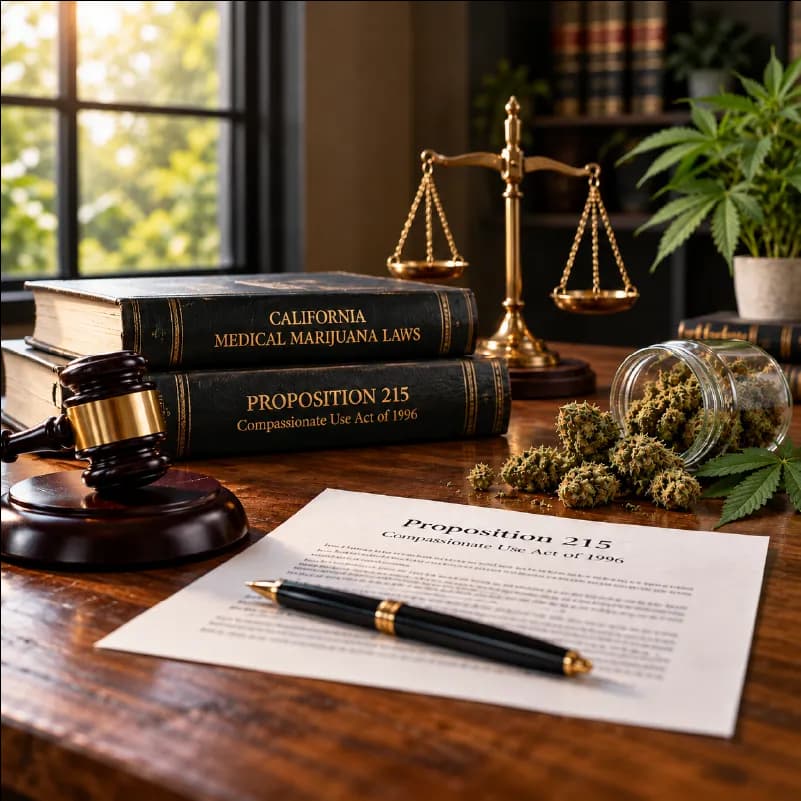
California’s medical cannabis journey began with Proposition 215 in 1996. The law gave qualifying patients legal protection to use marijuana for medical purposes and became the starting point for the state’s medical cannabis system. But California’s cannabis laws did not stop there.
Over the years, new laws changed the rules for medical patients, adult-use cannabis, businesses, and local governments.
So, what does Prop 215 mean under California’s laws today? In this guide, we’ll look at how Prop 215 shaped medical cannabis, what changed through later laws, and which important cannabis restrictions still apply in 2026.
What Is Proposition 215?
Proposition 215, officially called the Compassionate Use Act of 1996, made medical marijuana legal under California state law for patients who had a physician’s recommendation. It was approved by California voters in November 1996.
The law also provided protections for medical marijuana patients and their primary caregivers. It became the legal foundation for California’s medical cannabis system.
What Changed After Proposition 215?
Proposition 215 created the foundation for medical marijuana in California, but it did not provide detailed rules for how the system should operate. Later laws added clearer standards for patients, caregivers, identification, cultivation, and cannabis businesses.
Senate Bill 420 and the Medical Marijuana Program
In 2003, California passed Senate Bill 420 (SB 420) to clarify and expand the medical marijuana framework created by Prop 215. Major changes included:
- Possession and cultivation limits: SB 420 established statewide baseline limits of up to 8 ounces of dried cannabis and 6 mature or 12 immature plants for qualified patients, while allowing local governments to permit higher limits.
- Medical Marijuana Identification Card (MMIC): The voluntary program gave qualified patients and primary caregivers a state-recognized way to document their medical cannabis status.
- Patients and caregivers: The law provided additional statutory protections for qualified patients and primary caregivers who followed the applicable state requirements.
- Collectives and cooperatives: SB 420 provided a legal structure for qualified patients and caregivers to associate through nonprofit collectives and cooperatives for cultivating and obtaining medical cannabis at that time.
Proposition 64 and Adult-Use Cannabis
California voters approved Proposition 64, the Adult Use of Marijuana Act, in 2016. It legalized recreational cannabis for adults 21 and older.
This did not eliminate California’s medical cannabis system. Instead, the state now had two legal pathways: medical cannabis for qualifying patients and adult-use cannabis for adults 21 and older.
Senate Bill 94 / MAUCRSA: California’s Unified Cannabis System
California later moved toward a more unified regulatory system through Senate Bill 94, which created the Medical and Adult-Use Cannabis Regulation and Safety Act (MAUCRSA). It brought the following changes:
- Unified regulations: Medical and adult-use cannabis were brought under one broader regulatory framework.
- Licensed cannabis businesses: Businesses involved in cultivation, manufacturing, testing, distribution, and retail sales became subject to state licensing requirements. These licenses took effect on January 1, 2018.
- Local requirements: Cannabis businesses also had to follow applicable local rules and obtain required local approvals.
- Personal medical cultivation: California law allows certain personal cannabis cultivation outside the commercial licensing system, while cities and counties may impose additional cultivation restrictions, permits, or other requirements.
Prop 215 vs. California’s Medical Cannabis System Today
Let’s look at the evolution of laws from 1996 to 2026 through this comparison table.
| Features | Medical Marijuana | Recreational Marijuana |
|---|---|---|
| Legal use | Medical use only | Medical + adult-use |
| Medical access | Doctor’s recommendation | Recommendation + MMIC is voluntary |
| Business rules | No state licensing system | State licenses required |
| Taxes | Standard sales tax | Cannabis taxes apply |
| Local rules | Limited guidance | Cities/counties can set stricter rules |
| Product safety | No statewide testing rules | Testing, labeling, and packaging rules |
What Is the Status of Medical Marijuana in California in 2026?
Prop 215 laid the foundation for California’s medical marijuana system. Later laws changed and expanded that system, creating the rules that apply today. So, what parts of Prop 215 still matter, and what does California’s medical marijuana system look like in 2026?
What Remains Relevant from Proposition 215 Today
- Patients can access medical cannabis with a recommendation from a licensed physician.
- Adults aged 18 to 20 can use medical cannabis with a physician’s recommendation, while adult-use cannabis is for people aged 21 and older.
- Medical patients may have different possession and cultivation limits than adult-use consumers.
Current Medical Marijuana Law Updates
California’s current medical marijuana system also includes rules added through later laws and regulations. These include:
- Cannabis businesses must follow California’s licensing rules.
- Eligible patients can apply for a Medical Marijuana Identification Card (MMIC) through their county.
- Licensed cannabis products must meet state testing and safety requirements.
- Public cannabis use is restricted, and additional location-based rules may apply.
- The DCC updated several cannabis regulations in 2026, including rules related to cultivation, sanitation, testing, and licensing.
- Federal and California cannabis laws can differ. In 2026, federal rules changed for certain medical cannabis products, while adult-use cannabis remains federally illegal.
What Still Remains Illegal in California?
Even though cannabis is legal in California, some activities are still against the law:
- Cannabis generally cannot be smoked or consumed in public places.
- Driving while impaired by cannabis is illegal.
- You cannot legally take cannabis from California into another state.
- Cannabis remains restricted on federal property, including national parks.
- Cannabis businesses must have the required state and local licenses.
- Licensed retailers can only sell to adults 21+ or qualifying medical patients 18+.
- Cities and counties can set additional restrictions on cannabis businesses and activities.
Conclusion
Proposition 215 laid the foundation for medical cannabis in California. SB 420 added more structure, while Prop 64 and SB 94 helped create the broader cannabis system used today.
California’s cannabis laws have continued to change since 1996. That is why patients should look at the current 2026 rules instead of relying only on the original Prop 215 law.
Medical Marijuana Card California is a platform that provides updated information and a reliable telehealth platform to get your medical marijuana recommendation. Understanding these changes and reading information from trusted sites can help patients better understand their rights, responsibilities, and legal limits.